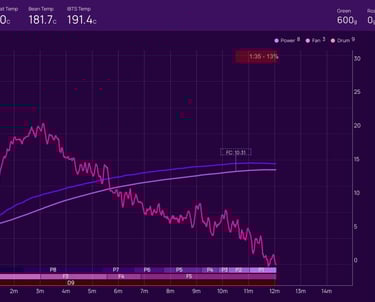
Our Roast Curves.


Panama - Roast 40
That roast is pretty much identical to Roast 39... it is... but the eagle eyed among you might see two key differences: 1) the bean temp; and 2) IBTS Temp.
No two roasts are ever really the same.
This has deeper brown sugar notes whilst still keeping the citrus fruit acidity. There is a good balance here and we are very pleased with it.
We have given out only a few samples and will share any feedback in the blog.

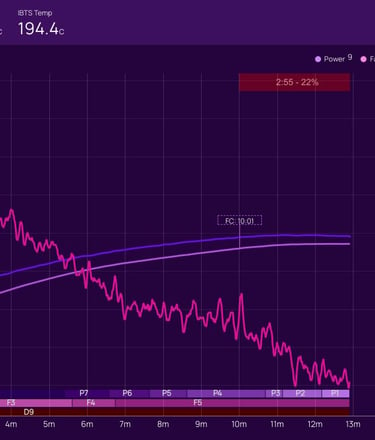
Panama - Roast 39 - Sample Roast!
We trialled a number of roasts making tweaks and adjustments as we progressed. And we are proud to share the curve for our Sample Roast!
Now I know what you are thinking... that is not a beautiful curve! Agreed. However the falvour profile is excellent. Top end clarity, rich milk chocolate and sweetness with some cheeky bright red fruit.
When I taste the coffee this curve looks beautiful to me!
This is a very limited run. We have a roasted weight of just 2kgs and at 150g per sample size, we will share about 17 samples of this batch.

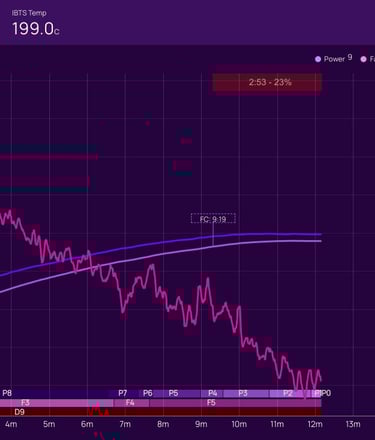
Panama - Roast 38
As planned, this roast was similar to roast 36, but with a few tweaks to ensure there was enough heat in the roaster to bring forward first crack and give us greater opportunity for a longer development time.
Overall, it was a success! The roast curve is a steady decline without any major tempriture spikes or drops mid roast. First crack arrived over a minute sooner and we held the development time from 20% to 23%.
The purpose of this roast was to see if these tweaks could bring out greater sweetness and top end clarity in the cup.
The coffee should degass for about 4-5 days before sampling so we will share results soon...
Panama - Roast 37
This was our hottest roast with a charge temp of 230 degrees C.
Its actually a nice roast from a flavour perspective, but there is a very, very slight hint of bitterness which is probably some scorching at the start of the roast on the outside of the beans.
The curve itself is quite neat and the heat present in the roaster progressed first crack by over a minute compared to Roast 36. However, first crack itself was too long, and this is probably due to the Fan level being raised quite quickly at this latter stage and the impact on the overall temp driving the beans through this important stage of the roast.
Some great learning from this roast! and Roast 38... as noted below in Roast 36, will have some important builds.

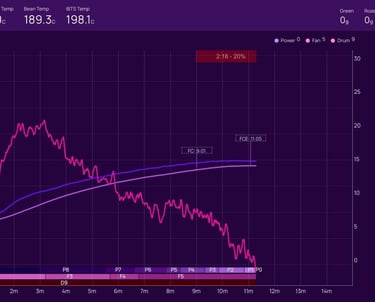
Panama - Roast 36
The charge temp here was 225 degrees C.
The roast curve flattens mid way though the roast which was not ideal but we kept on a downward curve and first crack was later and longer than expected.
This is likely due to our dropping the temp and raising the fan on the approach to - and during - first crack, which dropped the overall temp of the thermal mass needed to push the beans through cleanly.
On the next roast, we will hold P8 for an extra minute or so before dropping to P7, and hold the Fan at F4 for an extra 30s to one minute before raising to F5; this should help retain enough heat for an earlier and shorter first crack - then we can extend the development time from 20% to 23-25%.

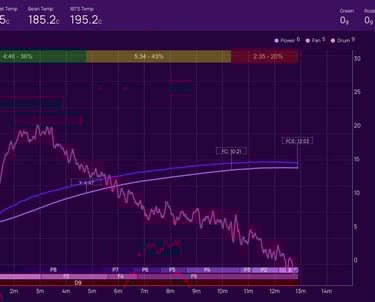
Panama - Roast 35
This was our first roast with this bean.
We played it safe, starting with a solid charge temp of 220 degrees C, and then followed a gentle progression to find first crack.
The density (high) and moisture readings suggested that we should increase the temperature to accellerate the drying phase and first crack to ultimately allow for a longer development time, in our next roasts.
In summary though, this roast was actually very nice. It was smooth with zero defects. However, it was clear that a longer development time was needed as the flavour profile was akin to a light tea with some fruit acidity and cereal notes.